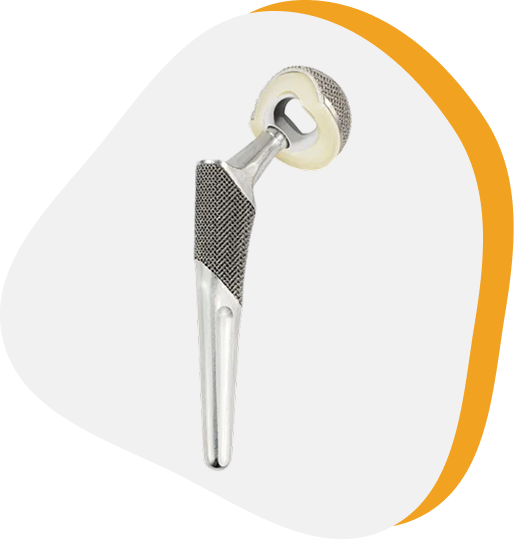
Canine THR is a surgical procedure in which the arthritic hip joint surfaces are replaced with a new prosthetic ball and socket. The prosthesis is designed to fit precisely and mimics the anatomy of the original joint. The arthritic joint is pain free after total hip replacement.
What is hip dysplasia?
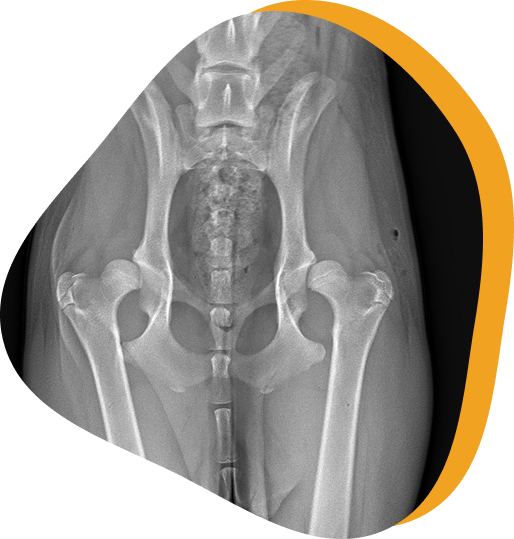
Hip dysplasia is an abnormal development and growth of the hip joint. Both hips are usually affected but symptoms may be more severe on one side. Hip dysplasia is manifested by varying degrees of laxity (looseness) of the hip joint with instability and malformation of the joint components. Arthritis is the long-term consequence of hip joint laxity.
Is My Dog a Candidate for THR?
The decision to proceed with THR is made after a thorough evaluation by our veterinary team. We look at several key factors to determine if your dog will benefit from the surgery:

Medical History
Many patients referred for hip replacement have other other orthopedic diseases and ultimtalely do not need a hip replacement.

Radiographs (X-rays)
We will perform calibrated radiographs to determine the appropriate size implants and evaluate each patient’s anatomy to confirm they
are a good candidate for the procedure.

Physical Examination
A comprehensive exam will allow the surgeon to assess your dog’s mobility, joint range of motion, and level of pain. The surgeon will also identify other conditions mimicking the symptoms of hip arthritis that may be treated with medicine or surgery.

Age and Size
While THR can be performed on most dogs, a dog should be skeletally mature (typically over 9-12 months of age). There is a wide range of implant sizes available to fit most breeds. Most dogs between 50 and 140 lbs are candidates for the procedure.
What does THR
surgery entail?
A THR involves removing both the arthritic ball (femoral head) and socket (acetabulum) and replacing them with an artificial ball and socket joint. The surgical procedure is precisely planned using several radiographic (x-ray) views and specialized templates that match the available implant sizes. The average length of the procedure is THR surgical procedure is approximately 75 minutes.
During surgery, the arthritic femoral head is removed, the acetabulum is prepared by removing the surface bone and cartilage and the implant, consisting of a metallic cup and smooth plastic liner, is inserted. Next, the femur is prepared by drilling out the center of the bone and impacting a pressure fit titanium implant into the femur, and the femoral component (stem) is implanted. A new metallic head is then placed on the stem of the femur implant and the hip joint is “reduced,” meaning the new metal head is inserted into the plastic cup. The hip is assessed for fit before the tissues are all closed.

What are the alternatives to Total Hip Replacement surgery?
Alternatives to THR include medical management of the pain or a surgical salvage procedure called a femoral head ostectomy (FHO). FHO surgery removes the femoral head and neck, helping to relieve joint pain but altering the biomechanics of the hip joint and typically does not generate the normal use of the leg that THR does. Medical management can include can include restoring a healthy weight, administration of non-steroidal anti-inflammatory drugs, nutritional supplementation, joint injections, or implementation of a rehabilitation program. Therapy under a rehabilitation & sports medicine veterinarian or specialist can provide years of comfort for a pet with painful arthritis.
for Owners
Preparing for your dog’s surgery is a team effort. Here’s what you can expect and how you can help ensure a smooth process.
Pre-Surgery
- Fasting guidelines will be provided.
- Anesthesia safety checks will be performed.
- You’ll have a chance to ask any final questions.
The Procedure
- Surgery can take 1–2 hours.
- Your dog will be under the care of a skilled surgical team.
- Pain management is a top priority throughout the process.
Post Surgery
- Your pet’s pain will be carefully monitored in the post-operative state.
- Each patient is walked with a sling to prevent slipping or falling.
- Patients are typically kept 1–2 days after surgery and sent home on oral medications.
Post-Operative Care and Recovery
The recovery period is critical for a successful outcome. You will receive detailed instructions for your pet’s care, but here is a brief overview:
Strict Rest
For the first 6–8 weeks, your dog’s activity must be very restricted to
allow the new joint to heal and integrate. This means leash walks only. The activity will be gradually increased.
Physical Rehabilitation
We will provide a plan for controlled exercises to strengthen muscles
and improve mobility.
Medication
You will be sent home with pain medication and sedatives.
Follow-up Appointments
Regular check-ups and x-rays will be scheduled to monitor your dog’s
progress.

Risks and Complications
While THR is a very successful procedure with a high rate of success (over 95%), like any surgery, there are potential risks. Our team takes every precaution to minimize these. Potential complications include:

Infection
Even though we use strict sterile techniques and provide pre- and
post-operative antibiotics, bacteria can enter the blood stream from
a host of sources and can lead to implant infection. However this is
typically uncommon.
Dislocation
A sling or harness will be recommended for the first 2 months. All slick floors must be eliminated to avoid slip and fall injuries early in recovery.
Femoral Fracture
Certain breeds are more predisposed so precautions are taken to prevent this complication.
Implant Loosening
Over time, implants can loosen, which may require a revision surgery. This is uncommon with modern implants.
frequently asked questions
Your veterinarian recommended this procedure because your dog is likely experiencing significant pain or a loss of mobility that can no longer be managed with simple lifestyle changes or pain medications. When the hip joint is severely damaged by arthritis or developmental issues, every step can feel like bone rubbing on bone. While pills can mask the discomfort, they don’t fix the underlying mechanical breakdown of the joint. THR is considered the “gold standard” because it addresses the root cause by replacing the worn-out parts. The goal isn’t just to help them walk, but to restore their quality of life so they can play, climb, and move without constant soreness. Ultimately, this recommendation is about moving from “managing disability” to “restoring ability.”
Hip dysplasia often shows up as a gradual slowdown in your dog’s daily activity, which many owners mistake for simple “old age.” You might notice your dog “bunny hopping,” where they move both back legs together instead of taking individual strides. They may struggle to get up from a wooden floor, hesitate before jumping into the car, or stop halfway up a flight of stairs. Some dogs show an obvious limp, while others just become “stiff” after a long walk or a nap. You might also notice their back end looks narrower because they are losing muscle mass from not using those legs properly. If your dog shifts their weight to their front legs or seems unusually grumpy when touched near their hips, these are clear signals of discomfort.
An FHO (Femoral Head Ostectomy) is a procedure where the “ball” of the hip joint is removed, leaving the body to create a “false joint” out of scar tissue. While an FHO can eliminate bone-on-bone pain, it doesn’t actually restore normal hip mechanics, often resulting in a shorter leg or a permanent limp. In contrast, a THR uses a prosthetic ball and socket to mimic a natural, healthy joint. This allows for a much faster return to a normal range of motion and full weight-bearing capabilities. For large, heavy, or highly active dogs, THR is significantly better because it provides the structural stability needed for running and jumping. Most owners find that THR dogs return to a much higher level of athletic function than those who undergo an FHO.
While THR is a routine procedure for specialists, it is still a major surgery that carries specific risks. The most serious concern is infection; because there is a metal implant involved, the body has a harder time fighting bacteria in that area. There is also a small risk of “luxation,” which is a fancy word for the new joint popping out of place before the muscles are strong enough to hold it. In some cases, the bone could fracture during the fitting of the implant, or the implant could fail to bond with the bone over time. Nerve injury is a rare possibility, which could lead to temporary weakness in the foot. However, we take extreme precautions, including sterile “space suit” environments and rigorous testing, to keep these risks as low as possible.
Not every dog is a candidate for THR, and safety is always our first priority. If your dog has an active infection anywhere—such as a skin hot spot, a urinary tract infection, or bad dental disease—the surgery must be delayed because bacteria can travel through the blood to the new hip. We also look closely at neurological health; if your dog has a spine issue that prevents them from feeling or controlling their legs, a new hip won’t help them walk better. Very young dogs whose bones are still growing rapidly may need to wait until they reach skeletal maturity. Additionally, if a dog’s behavior is so wild that they cannot be safely confined for recovery, we may need to reconsider. Finally, some very small dogs or those with mild symptoms may do just as well with non-surgical management.
You can take comfort in knowing that Total Hip Replacement has one of the highest success rates in veterinary orthopedics. Generally, about 90% to 95% of dogs who undergo the procedure enjoy a complication-free recovery and a total return to function. Most owners report that their dogs seem “years younger” once the surgical soreness wears off and the chronic joint pain is gone. Even in the small percentage of cases where a complication occurs, most can be managed or corrected with additional care. Long-term studies show that the vast majority of patients live out the rest of their lives without ever needing a second surgery on that hip. It is widely considered one of the most life-changing procedures available in modern veterinary medicine.
Unlike human hip replacements, which may need to be “redone” after 15 or 20 years, a dog’s THR is designed to be a permanent, lifetime fix. Because dogs have a shorter lifespan than humans and weigh significantly less, the medical-grade titanium and specialized plastics don’t experience the same level of long-term wear and tear. Once the bone has fully grown into or bonded with the implant, it becomes a structural part of your dog’s skeleton. It does not “wear out” from running or playing, so there is no need to limit your dog’s activity once they are cleared by the surgeon. Barring a very rare late-stage infection or a major injury to the bone around the implant, the hip your dog gets today will be with them for the rest of their life. You can expect them to enjoy their senior years with the same mobility they had as a young adult.
The road to recovery is a marathon, not a sprint, typically lasting about 12-16 weeks. For the first several weeks, your dog must be strictly confined to a crate or a small, padded room to prevent them from jumping or slipping, which could dislodge the new joint. You will need to take them outside on a very short, controlled leash for “potty breaks” only—no off-leash time or stairs allowed. As the weeks progress, we will introduce physical therapy exercises, such as slow hill walks or underwater treadmill sessions, to rebuild the muscles that shrunk during their time of injury. Periodic X-rays will be taken to ensure the bone is healing perfectly around the metal parts. While the restriction is tough on both you and your dog, it is the most critical factor in ensuring the surgery is a long-term success.
Get In Touch
 Location
8033 Cooper Creek Boulevard,
#101, University Park,
Florida 34201
 Phone
Phone
941.893.1500
 Email
Email
info@vscsarasota.com
 Office Hours
Monday – Friday 8:00am – 5:00pm
Saturday & Sunday – Closed